
Turnstile Gate with Facial Recognition
Learn how a turnstile gate with facial recognition works, including components, compatible…

Phone: +86 19540588776
WhatsApp / Wechat: +86 19540588776
Email: info@yunshao.com
Address: Building 6, Guanlan High-tech Industrial Park, Longgang District, Shenzhen City, Guangdong Province, China
Page Catalog
QR code turnstile access control systems combine credential scanning, access validation, and automated pedestrian gates to manage who can enter a building or venue. They are used for visitor access, ticket validation, employee entry, and membership-based facilities. Unlike a standalone QR scanner, a complete system must coordinate the reader, controller, software, and turnstile so that an approved credential results in a safe, traceable passage.

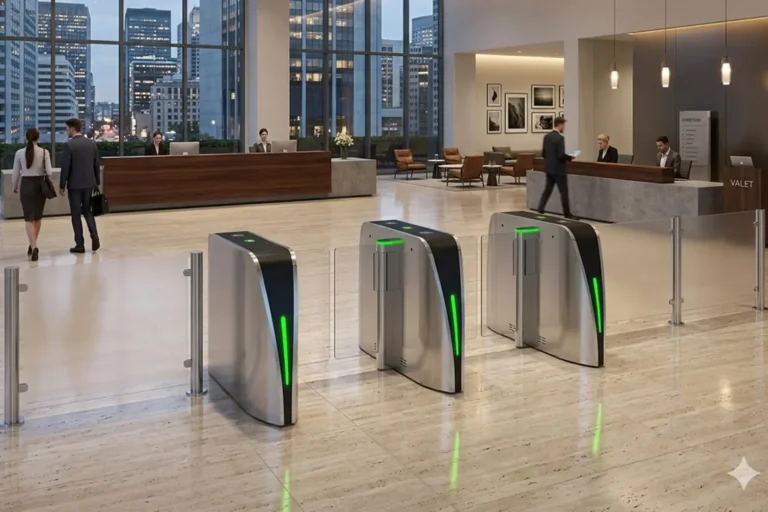
A QR code turnstile system uses a QR credential displayed on a phone or printed on a ticket to request entry through a turnstile gate. The QR code may contain an identifier or a signed token. A reader decodes it, and the appropriate controller or software checks whether entry is permitted.
The turnstile provides the physical barrier and passage sensors; the connected access control or ticketing platform applies the rules. These rules may include validity periods, approved entrances, visit limits, or membership status. The exact division of functions depends on the selected devices and system architecture.
A rejected, expired, or previously used credential should not release the gate when the project rules prohibit access. The system should also handle a valid scan followed by no passage, so an unused authorization does not create an unintended entry opportunity.
Important: A QR code reader does not automatically provide a complete access control system. Credential issuance, authorization logic, gate control, and event handling must work together.
Integration is often the most important part of a QR turnstile project. For example, a visitor management platform may issue a temporary code, while a ticketing platform may require one-time admission. The system integrator must determine where verification occurs and how the authorization reaches the turnstile.
Before deployment, confirm protocol compatibility, data format, direction control, response time, and who is responsible for software integration. Also define how the system responds to a network outage, duplicate scan, invalid code, or passage timeout. Not every YUNSHAO reader or gate supports every interface; specifications must be verified for the chosen configuration.
The security of a QR turnstile system depends on how credentials are generated and validated, not simply on whether the code is static or dynamic. A static QR code can be convenient for repeat users but may be copied or shared if additional checks are absent.
For emergency situations, turnstile behavior must follow the approved fire and egress design. Security rules should never be implemented in a way that compromises required emergency exit routes.
Office buildings can issue time-limited visitor QR codes, while gyms and fitness centers can connect member credentials to subscription permissions. Stadiums, attractions, and event venues commonly use QR tickets for admission validation. Construction sites may use temporary credentials for approved workers and contractors.
For projects focused on admission tickets, explore YUNSHAO’s Ticketing Turnstile Gate System. If you are comparing scanners and compatible gate styles, see our QR Code & Barcode Turnstile Gates Buying Guide.
YUNSHAO is a Shenzhen-based turnstile gate manufacturer established in 2010. We supply pedestrian turnstile hardware and support OEM/ODM customization and project-specific integration with compatible QR code readers, access controllers, and third-party platforms. Our turnstile products include a 3-year limited warranty for qualifying manufacturing defects, subject to the warranty policy, and lifetime technical support.
Some reader/controller configurations can issue an opening signal, but the authorization logic, signal compatibility, and gate safety settings must be checked for each project.
Often yes, if the software and selected hardware provide compatible APIs, SDKs, controller interfaces, or supported protocols. Integration requirements should be confirmed before purchasing.
A static code usually remains unchanged, while a dynamic code may rotate or expire. Security depends on validation, token protection, expiry rules, and replay controls—not the label alone.
Some systems can validate credentials locally or use cached permissions, but offline behavior must be designed and tested. A network outage does not automatically mean every QR system can continue operating.
Speed gates, swing turnstile gates, flap barriers, and dedicated ticketing gates may all be suitable. Choose according to lane width, traffic volume, accessibility, installation conditions, and reader compatibility.

Learn how a turnstile gate with facial recognition works, including components, compatible…
Explore OEM & ODM turnstile gate manufacturing, custom designs, private labeling, access…

Learn how QR code turnstile access control systems work, including scanners, controllers,…